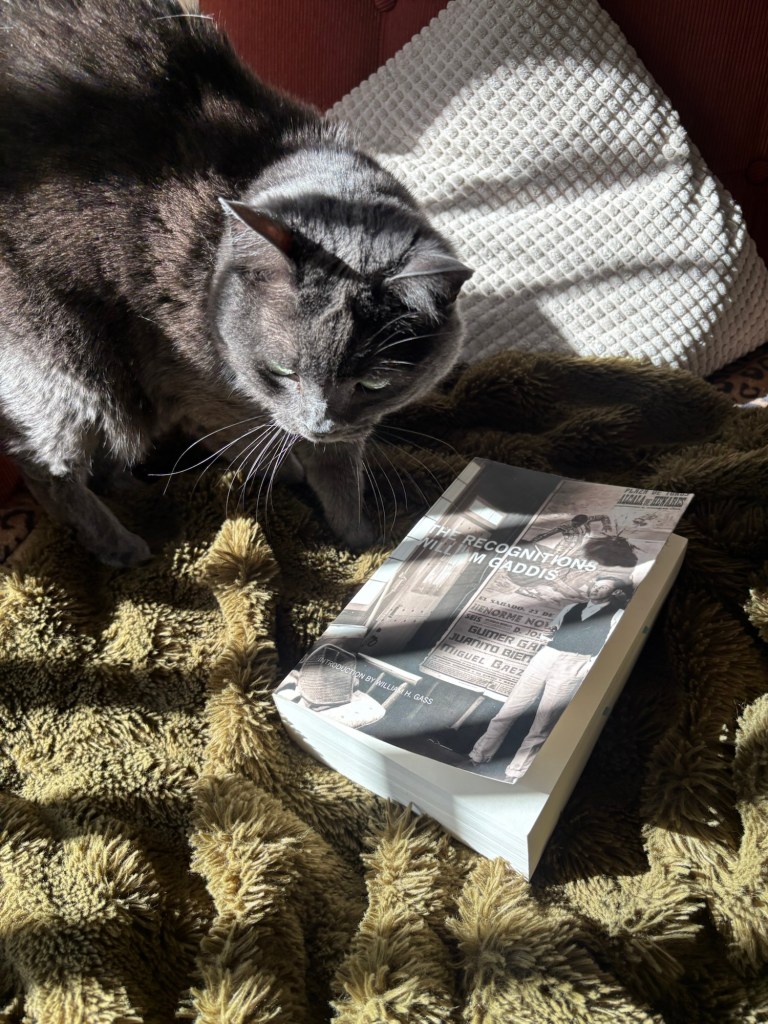

While reading this book alongside my good friend Dallan, we got talking about a scene where Gaddis is satirizing men who read self-help books, musing that they seek “the self which had ceased to exist the day they stopped seeking it alone.” Now, I’ve never been a fan of self-help, so I was here for the comedy, but it got me thinking. I asked Dallan, “Is it even possible to seek the self alone? Are we not always modelling ourselves after something? If not self-help books, then our parents and peers, characters we see on TV and read in books? What is the ‘self’ then?”
A few days later, I was at band practice, bass guitar in my hands. We had just finished playing a song, and I was staring into the far corner of the room, spacing out, as I do, and I was suddenly overcome by a feeling of falsity in my own skin. I could see my own personality as a construct of layers, a collection of defense mechanisms and mirror images, habits and tics that I could peel off one by one like the layers of a papier-mâché doll—layers that could be traced back to their original creator, who inhereted them from someone else, ad nauseam. It might be the first time I experienced something I could only describe as ego death. I felt, momentarily, like underneath my identity was a tabula rasa, a blank slate that I could reconstruct in any way that I desired. It was freeing, honestly, but it didn’t last long; my brain quickly resumed its natural processes, keeping me safe with a sense of self that allows me to move through the world without falling apart.
The Recognitions? Oh yeah, it’s a good book. Very deserving of its reputation. It is a strange beast, murky and virtuosic, full of hidden symbols, but also funny, with strong characterization and incredible dialogue. I was surprised by how much of it reads like a comedy of errors, yet other parts of it had me doubling over, scratching my head to understand the who, what, and why of it all. I guess in the world of art forgery it is common to damage the product to make it look more genuine, as if it had been weathered by centuries, and it felt like that is what Gaddis was doing with his own book, going back and scratching out faces, obscuring identities, smudging the ink so that the truth becomes a matter of interpretation. I loved that about it, even though it was challenging. I have to thank Dallan for helping me understand some scenes that I wildly misinterpreted, but I’m glad Gaddis got what he wanted out of me: a total dissolution of my reality.
There are scenes from this book that will haunt me forever, and multiple layers of metaphor and reference that will take multiple rereads for me to understand, but for now, I just want to appreciate how this book gave me a new perspective on myself, and what I am made of. I feel like I am a little bit closer to understanding what Borges meant when he said “I am all other men, any man is all men.”
Leave a Reply