


Tag: hyperion cantos

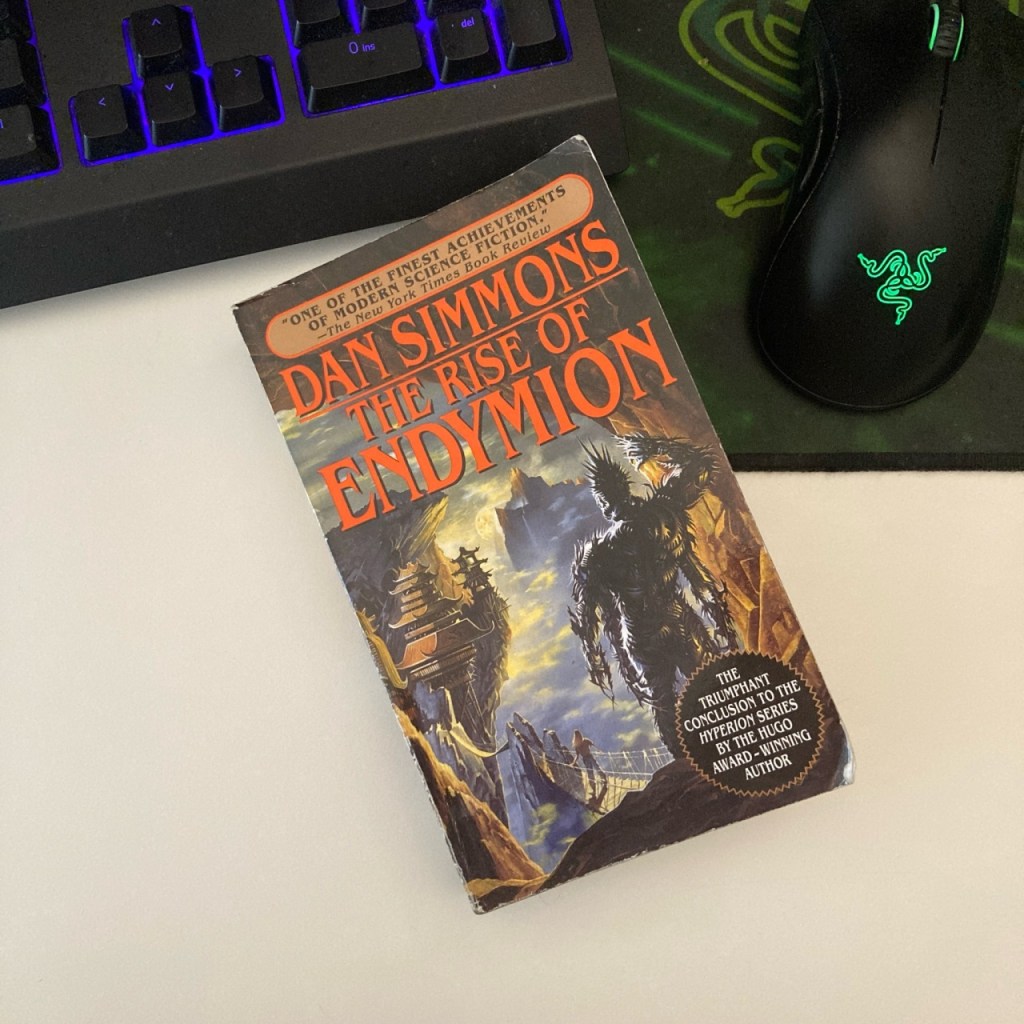
  • Book Review: The Rise of Endymion by Dan Simmons (1997)

    🌕🌕🌗🌑🌑

    Finally wrapped up the Hyperion Cantos. It’s a bitter sweet moment. This final book is hard for me to talk about. I could probably write a thousand words about it, but I’ll try to keep it brief, because brevity is the soul of wit. Something Dan Simmons could have considered, perhaps.

    The Rise of Endymion was a struggle to get through, to be honest. The prior book (simply; Endymion) was a fun, action packed interplanetary man hunt with relatively consistent pacing and enough turns and twists to keep things engaging. This one is hardly any of those things. The pacing in this book was straight up bad. Simmons’ writing is at it’s best when things are happening, but every time some form of action happened in this book, it was cornered by ten page descriptions of clouds and the colour of peoples clothes that frustratingly interrupted the flow. Hell, the entire section on T’ien Shan felt like a data dump with only brief sections of actual plot movement. The monologues were also so rough to sit through because it felt like Simmons was just using character speeches as another way to dump data, summarizing things we already know and tying up loose ends that honestly would have been better left as mysteries.

    Aenea and Raul continue to be shallow characters as well, which is nothing new, but this time the good characters weren’t utilized enough to make a difference. Raul displays some incredibly eye rolling and predictable behavior during the course of the book as Aenea turns into some flat, robotic guru figure. She’s supposed to be the symbol of empathy, but her emotions were not convincing in the slightest (I guess she is part cybrid after all). Aenea and Raul’s entire relationship just bordered on creepy and unbelievable. The only interesting development from Aenea was at the very very end where she shows an uncharacteristic burst of impulsivity and rage. Father De Soya still remains the best character, even though he was absent for large chunks of the story, and A. Bettik had hardly any presence at all. The Shrike still shows up but isn’t even scary or interesting anymore because it’s basically the good guy now. Most of the other side characters were forgettable, there were simply too many of them to keep track of in the first place.

    I can count the actual exciting moments in this book on one hand. It’s way longer than it needs to be, it’s packed full of unnecessary information that disrupts the flow, it’s cringe inducing and ridiculous at times. It’s also very, very heavy on the romance and religious philosophy. Simmons is lucky that I mostly agree with and respect his feelings on religion, or I probably would have stopped reading it. Organized and corrupt religious institutions are the bad guy in Simmons’ books, but he also preaches the beauty of faith and love and ability to choose what one believes in without judgement. It’s all wonderful stuff, but sometimes it’s so on the nose that it feels like a personal rant from the author.

    Despite all of that, I still loved this book. Simmons really turned things around in the last 150 pages or so, and wrote the best possible ending that he could have, which was a total shock to me as the endings of all the previous books were pretty lackluster. It made the entire slog feel so worth it. It was riveting, tragic, beautiful, profound, it put me in tears, god damnit. I was weeping like a child. Not only because of how good it was, but also because it hurt to close the last page on a world and characters that I’ve spent the last four and a half months immersed in. Would I recommend it? Not really… but despite how utterly disappointing this book was at times, I still feel forever changed by the world and philosophy of the series, and I’m glad I stuck it out to the end.
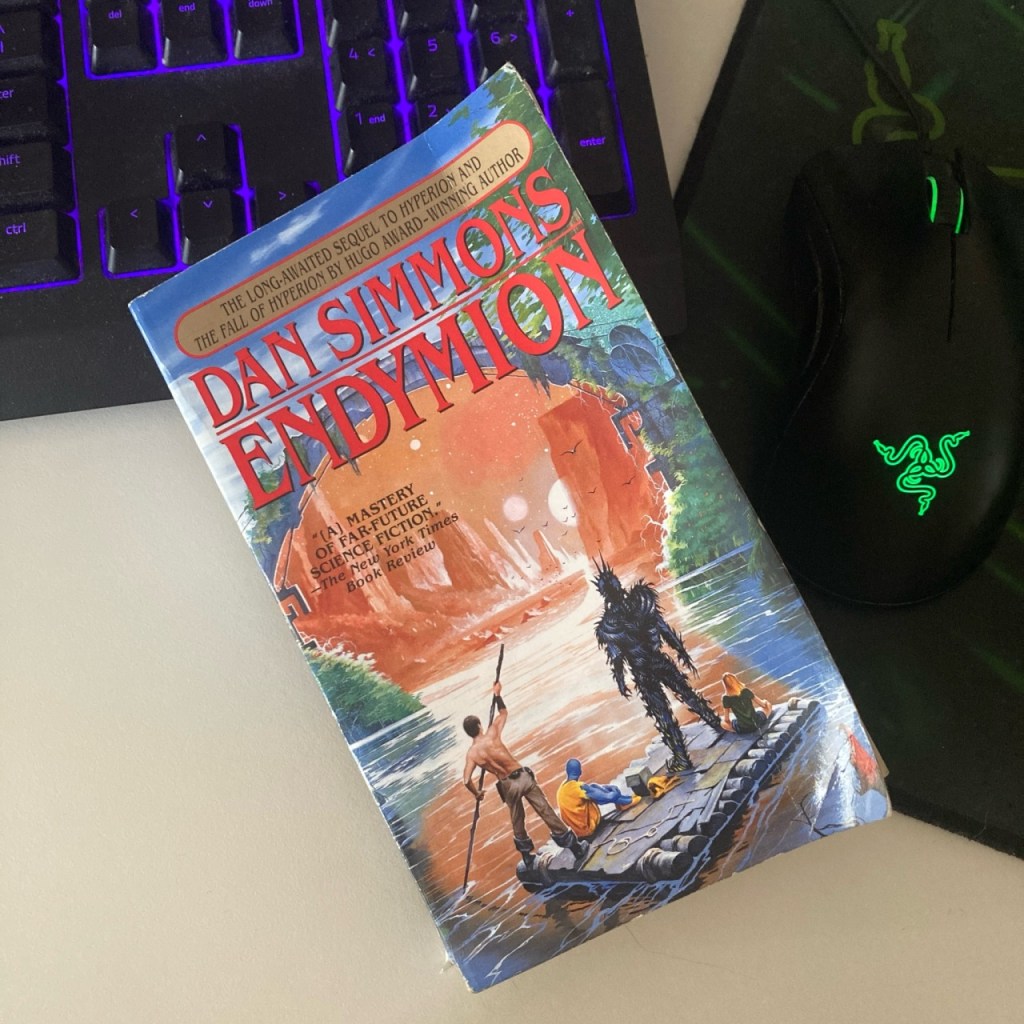
  • Book Review: Endymion by Dan Simmons (1996)

    🌕🌕🌕🌗🌑

    This book surprised the hell out of me. The general consensus online and amongst people I know who have read Hyperion, is that Endymion and The Rise of Endymion are not as good. A majority of people don’t even bother reading them. Those people are missing out, and I don’t put that lightly. Luckily for me, I bought all 4 books in the Cantos without looking up any ratings or reviews, so my choice became; read all of them, or waste your money. I was hesitant to start this one, and it did honestly have a bit of a rough start, but I was head over heels for it by the mid way point.

    Endymion is a masterclass in world building, if nothing else. It takes place 274 years after the fall of the Hegemony, and the destruction of the TechnoCore and it’s network of farcaster portals which connected the web worlds with instantaneous travel. Simmons did an amazing job at evolving his universe over this enormous gap in time. Planets became isolated from each other, terraforming projects failed and mother nature returned these worlds back to their natural state, billions died of starvation and war, or simply by getting stuck on the wrong side of a portal after the fall. During this dark age, The Church harvested the cruciform parasites from the labyrinth of Hyperion and harnessed the power of immortality to colonize former web worlds and essentially create their own version of a religious hegemony. The irony here is that despite harvesting the cruciforms which were created by the TechnoCore, the Church admonishes artificial intelligence and has banned the manufacture or use of AI tech. This distrust of AI permeates culture so much that there are even points during the story where the main characters straight up decline vital help or knowledge from the Consul’s old ship and comlog device, claiming it’s useless and essentially telling it to shut up. A small but humorous detail. With the power of immortality in hand, the Church was also able to create a new kind of space craft which was unconstrained by the limits of the human body’s ability to withstand extreme g-forces. These new space crafts could travel anywhere almost just as fast as they could have by using a farcaster portal, with the understanding that the occupants of the craft would die immediately, and be resurrected upon arrival to their destination. It’s truly fascinating stuff, and it proves that Simmons’ unique and borderline outlandish ideas didn’t die with The Fall of Hyperion. He clearly had some juice left in the tank for this one.

    The book has some great characters too, just maybe not who you would suspect. The main character, for example, is simply a vessel for us to watch the story unfold. Raul is a typical commoner-thrust-into-heroism type character with seemingly little in the way of personality or flaws, save for a smidge of overconfidence. This is not to say he is unlikeable, he is just a little too perfect and predictable to be interesting. Aenea was not that interesting either, apart from the fact that she is the hybrid child of a human and AI cybrid, who can contact the assumed-dead TechnoCore through her mind and activate old farcaster portals on the River Tethys.

    Who are the good characters, you ask? A. Bettik and Father Captain Frederico de Soya. A. Bettik is an android servant who Raul recruited from under the care of Martin Silenus to aid in his quest to protect Aenea. He is cool, calm, collected, largely impassive, and sports an unintentionally humorous deadpan delivery. Despite his cold android personality, I was constantly surprised by his displays of courage and humanity. He was the rock that held the group together, and I honestly almost cried when he lost his arm and almost died near the end of the book. Father de Soya on the other hand is the Pax officer and Catholic priest who is tasked with capturing Aenea. Throughout the journey, he displays surprising complexity as he undergoes a hundred deaths and resurrections that slowly drives him mad. Despite being solely responsible for Aenea’s capture, de Soya is not the bad guy. Yes, he is faithful and obedient to the Church, but he’s also smart enough to know when the truth is being manipulated, and can make decisions based on his own judgement. He ends up being possibly the best written character in the entire series.

    The main story arc of Endymion is essentially just an interplanetary manhunt. It’s a much simpler and more linear tale than Hyperion, but I’d argue that it’s also more fun. Being taken on a wild ride down the River Tethys, revisiting all of these planets and finding out how much they have changed since The Fall, all the while being relentlessly pursued by someone who is dying over and over and over again to fulfill his duty to the Church… it’s all so fascinating and exciting. By the time I was ¾ of the way through the book, I was finishing every single chapter with an audible string of “holy shit, oh my god, what the fuck”. If you have read the two Hyperion books and were unsure of whether or not Endymion is worth your time, I promise you it is. If you love the world that Simmons created, then there is more than enough here to satisfy your thirst. Time for me to jump into the finale.

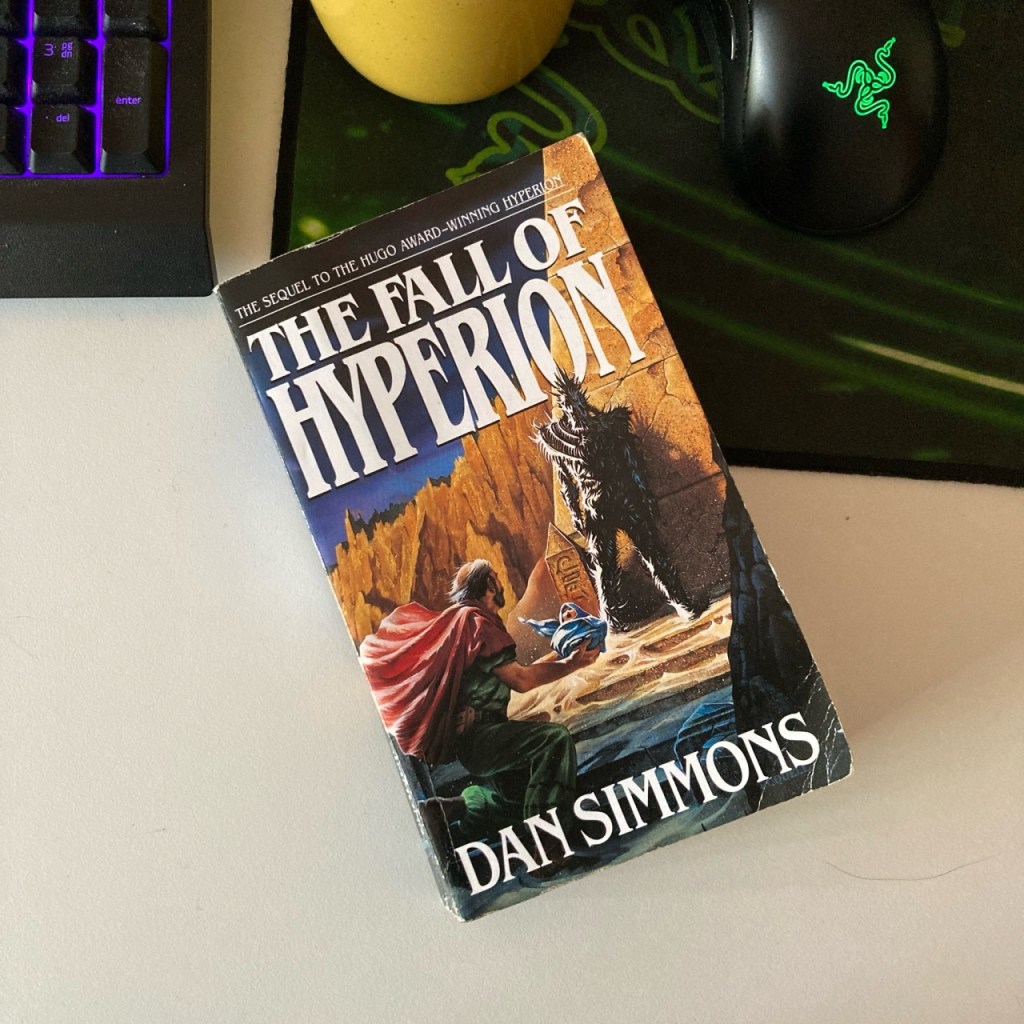
  • Book Review: The Fall of Hyperion by Dan Simmons

    🌕🌕🌕🌕🌕

    Wow wow wow. Finally finished up The Fall of Hyperion. These books have been taking me a while to get through, but now that I’m done, I almost wish I had read it slower. I straight up didn’t want it to end.

    I’m really glad that the first book in this series got all of the world building and character introductions out of the way, because this one was just cooking the entire way through. I was stunned by the amount of insane shit happening before even hitting the half way point of the book. There are just so many different elements at play here; you have the pilgrims on the ground of Hyperion, dealing directly with the trials and terror of the Shrike and his Tree of Thorns, the intergalactic war being waged between the Hegemony and the Ousters, the Keats persona acting as an information relay and flying through the datasphere to communicate directly with AI gods, the Templars and the Shrike Cult with their prophecies, and then the three factions of the TechnoCore being shady and pulling strings in the background the whole time. It’s insane how Simmons’ managed to hold all of these elements and vessels of storytelling together in a cohesive manner that never felt overwhelming or too confusing. The whole concept of timelines intersecting as things pertaining to the tombs ether traveled forward or backward in time kind of went over my head a bit, but it wasn’t too much of an issue.

    I’ll admit the ending was a little corny/sloppy, for lack of a better word. It seemed like Simmons’ was grasping at straws a bit in the final chapter just to tie up loose ends, and he also went a little off the rails with the philosophy of “God” and the “Power of Love” and the “Human Spirit” or whatever. I feel like he was trying to add deeper meaning where it wasn’t really necessary, and it came across as a tad pretentious. There are two themes that really stuck out to me while reading this, and neither of them had anything to do with God or love or the human spirit. The first is sacrifice. Without giving away too many spoilers, almost every Pilgrim had their wish granted by the Shrike, albeit in a roundabout way with a caveat that caused them to sacrifice something great, even if that was their own life. The second was the theme of opening our arms to convenience and becoming it’s captive. I think Simmons’ take on how an over reliance on technology can have terrible consequences for the fate of humanity was actually quite nuanced and ahead of it’s time considering this book was published in 1990. There are some very valuable lessons to be gained from this story.

    Overall this book really went so far above and beyond the scope of the first, and I’m so glad I decided to take the plunge and see it through. It will probably be hard for any other sci fi novel to beat. I’ve heard that Endymion and The Rise of Endymion are not as good, but I just have to read them now. There were still so many questions left over at the end. Are there still more Shrikes lying in wait? What is really behind the door in the Shrike Palace?? I must know.

Something went wrong. Please refresh the page and/or try again.