🌕🌕🌕🌗🌑
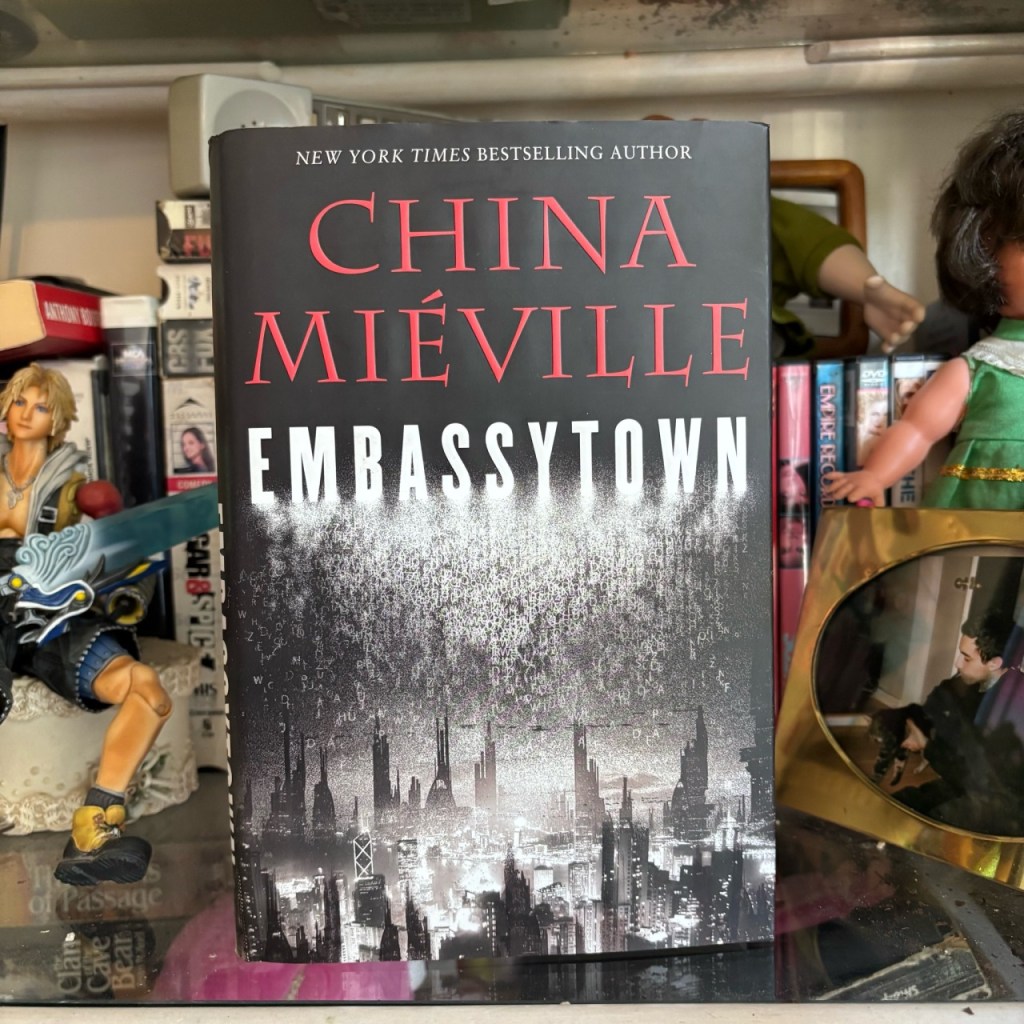
I don’t think I’ve ever been more conflicted about a book in my life. Torn between 3 or 4 stars, but I’ll leave it at 4 while I huff my copium. I could sum up this whole review with a GIF of someone crossing their arms and saying “I’m not mad, I’m just disappointed”. This is not a bad book, it just could have been so much better. It didn’t live up to its full potential because the plot doesn’t do justice to the world building, and that is why I am sentencing you to garbage duty for the rest of the week, son.
Good thing the world building is strong enough to carry most of the read. The first hundred or so pages were honestly the best part of the whole book. Our first person narrator, Avice Bennet Cho, introduces us to the sociology and politics of Embassytown (a human colony state on an alien planet) through a tapestry of past and present narratives. We get to hear Avice describe memories of her childhood growing up in Embassytown, and about her career as an Immerser (basically someone who can navigate through the pocket dimensions of space without getting sick). Through this we also get to learn about the strange ways and language of the Ariekei aliens who are native to the planet, and about their symbiotic relationship with the humans in which they trade medicine and other goods for Ariekene bioengineering (yes, there are weapons, buildings and machinery made out of sentient flesh, it’s awesome). We also get to learn about Avice herself, who honestly begins as a fairly compelling protaganist. Miéville subverts a lot of tropes in building her character without ever being showy about how “different” she is. In fact, most of the characters read as very normal, regular people, and I appreciate that level of detail to human behaviour. He even did a great job at writing one of the AI characters, Avice’s best friend Erhsul, who can imitate human empathy well enough to form real relationships while remaining frustratingly calculative and mechanical.
Arieka is genuinely the most interesting and well thought out alien world I’ve ever read about, and the book has such a clever narrative hook centred around the evolution of language being both devastatingly dangerous but also liberating and ultimately progressive. So why am I so conflicted?
Well, the main plot hinge is sudden and underwhelming (I think it’s meant to be a “small rock, big ripple” type of event but it’s not done very convincingly), and then the entire story from there on switches gears in a way that feels so counterintuitive to the setup. Things in the world begin rapidly changing, and the dual timelines coalesce into one present narrative. The scope of the story rapidly expands from interpersonal to factionary, and our once interesting, well developed protagonist gets flattened down to the personality of a news reporter—speeding through a list of current event headlines just to clock out of her shift a few minutes early. Almost 240 pages of “this happened, and then this happened, and then this happened, and then this happened” ad nauseam. It’s like sitting on a train and watching images flicker past. Sure, the landscape is visceral, and the quick pace keeps things engaging enough, but I couldn’t help but feel like the slow set up—the walk to the train, if you will—was where Miéville really shines. If the story would have just maintained a closer focus, and found some subtler avenue for expressing change, this could have easily been a masterpiece.
Fortunately, Miéville’s prose mostly makes up for his clumsy handling of narrative. He might be one of my new favourite writers on a purely sentence to sentence basis. He has a fairly lofty vocabulary, and also throws a ton of future slang at you without holding your hand too much, leaving you to search for context clues (this is actually a good thing that I enjoy), but he is also just a master at manipulating sentence structures to maintain clarity while still coming across as playful. There were so many sentences that I had to read twice or thrice not because I didn’t understand them, but because I was just fascinated by the clever wording. The prose itself was the second best thing after the world building, so even when the plot took a nose dive, I was still turning pages like nobody’s business.
Ultimately, Miéville hit a home run with the set up and then tripped and slid somewhere between second and third base, making for a highly entertaining but clumsy play. The fact that this book never lived up to it’s potential will be a thorn in my side for the rest of time, but I am still absolutely sold on Miéville as a writer, and can’t wait to read more of his works.
Leave a Reply