🌕🌕🌗🌑🌑
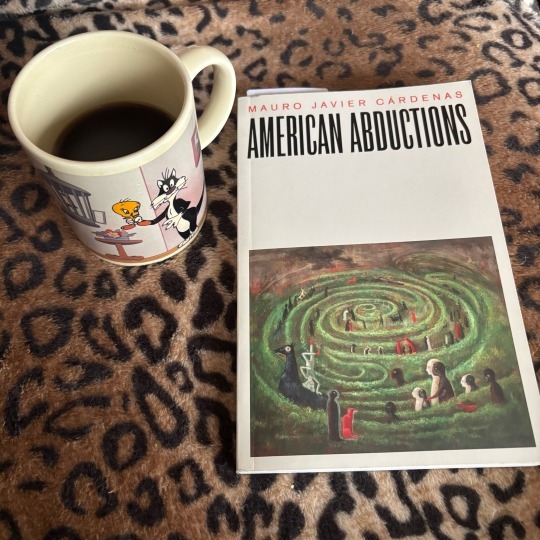
Do not fall for the marketing spiel on the back of this book; whoever wrote it was working overtime to give American Abductions the best chance at being plucked off the shelves, because if they were completely honest about the content of the book, it would be a hard sell. It is nothing like PKD or Samuel R. Delany, and it has no cohesive plot. This doesn’t mean it’s a bad book, however.
American Abductions is about the deportation of Latin Americans living in a not-so-far-flung technocratic fascist USA, and it does have something to do with two sisters who lost their father, first to deportation and then to death, but the way it approaches telling these stories of abduction and torn-apart families is through a series of recorded interviews that have seemingly been scrambled, scrubbed, altered, perhaps even fed into AI language models, and then spat back out for a purpose I never managed to put a finger on, but maybe it has something to do with avoiding detection by surveillance systems? I’m not so sure. The result is what you get on the page is a largely incomprehensible jumble of words and disordered allusions that make up a string of codified speech for the reader to decipher.
The prose in this novel is actually quite fun once you get used to it. It is highly experimental, lacks punctuation, and purposely ignores the rules of grammar to mimic hurried human speech. I feel like every time I opened this book my pupils would dilate, and I would fall forward into a river of words that make little sense but somehow manage to translate enough raw emotion to keep me on the line. It’s kind of like tuning into a fuzzy radio station, and every once in a while the signal becomes clear and you hear a tiny snippet of a familiar song before the signal goes fuzzy again. That being considered, it’s impressive how Cárdenas managed to keep my attention for 230 pages by providing a visceral reading experience in lieu of a plot.
American Abductions is also packed full of literary references from Leonora Carrington to Roberto Bolaño, Thomas Bernhard, W. G. Sebald, Jorge Luis Borges, and probably more that I’m forgetting. It typically irks me when authors shoehorn literary name-drops into their works as if they are trying too hard to weasel their way into a circle of giants, but in American Abductions, these references are used to build a fabric of communal memory in a way I thought was marginally touching.
But alas, the success of this book lies in the readers’ tolerance for nonsense, of which there is plenty. Luckily it is a quick enough read that I didn’t feel my time was wasted (took me 3 days at my slow pace), but I wouldn’t recommend this to anyone unless you enjoy high-risk, medium-reward experimental lit. Yeah, maybe I just “didn’t get it,” but this book is so purposely obfuscated that I feel “not getting it” is kind of the author’s intent. You’ll never understand the frenetic paranoia of being an immigrant in a fascist surveillance state unless you live it. Read at your own risk.
Leave a Reply