🌕🌕🌕🌑🌑
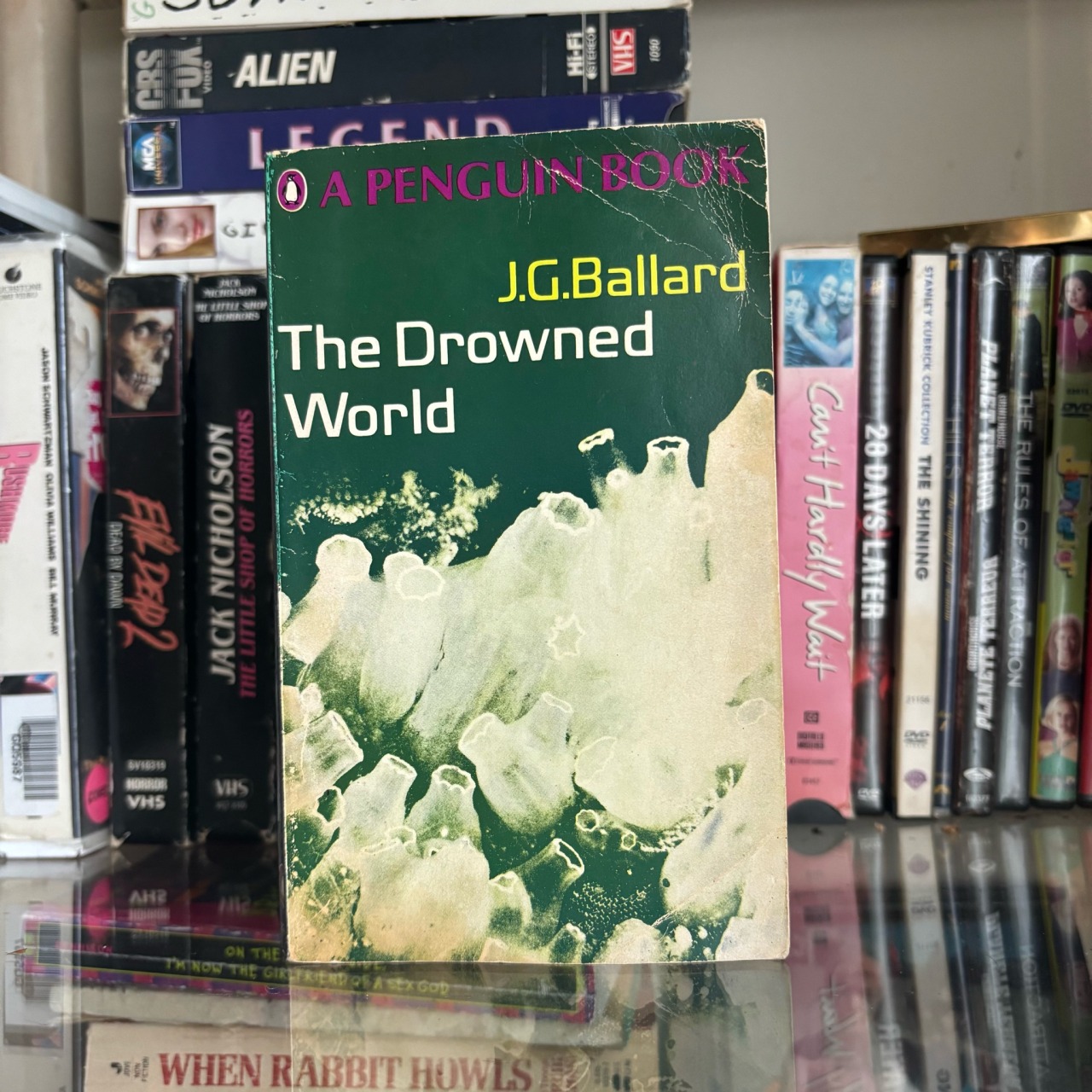
Picked this up as a short (170-page) palate cleanser after the head-bashing torture that Moderan put me through, and it was the perfect book for the job. This was my first J. G. Ballard experience, and, to be honest, I was expecting something a little more challenging, more in line with what I’ve heard about Crash and High Rise (which I will read soon). But to be fair, this is only Ballard’s second published novel, and through my reading I could get the sense that he was very much still trying to formulate his own style within the confines of what is essentially a small set-based story.
The Drowned World, as the title suggests, takes place in a (perhaps not so distant) future where climate change has caused the sea levels to rise so high that the ocean has swallowed entire cities whole, and the only real inhabitable zones left are the Arctic poles. But that doesn’t mean there aren’t people out there still clinging to memories of the past, surviving in the upper levels of apartment blocks that still poke out of the water like the steel and concrete fingers of a corpse, sweltering in temperatures that exceed 100 degrees Fahrenheit. There are still biologists in the hot zones trying to keep up with the accelerated evolution of plant and reptile life, reclusive widows, and crocodile-whispering treasure hunters spelunking for forgotten artifacts.
The scope of The Drowned World is quite limited; as I mentioned, it is a set-based story that takes place mostly in the confines of one lagoon that has formed in the city of London, but in lieu of adventure, The Drowned World opts to explore the effect that severe climate change can have on the human psyche. Ballard plays with the idea that changes in climate can unlock memories of the Mesozoic era baked into our DNA, and as our characters spend more time in this sweltering jungle lagoon, they become haunted by dreams of giant reptiles and an obsession with following the sun south to the equator, where they will ultimately die from heat exposure (possibly a calling back to the birthplace of humanity in the African continent?). Honestly, this idea, despite adding a unique (and quite psychedelic) flavour to the novel, was never fleshed out in a satisfying way, although it did come in clutch to add an unsettling poignancy to the ending.
The bulk of the story is ultimately centered around our main character, Dr. Kerans, and his clash with Strangman, the deranged treasure hunter. The relationship between these two characters (as well as our ancillary cast) is probably the most fun part of the story. Their relationship begins cautious but amicable but progressively becomes more estranged as Strangman psychologically toys with Kerans like a cat and mouse. And that is ultimately The Drowned World’s greatest strength—its atmosphere of psychological oppression. Take the delirium caused by sweltering heat and the dilution of memory, and combine it with a maniacal, violent treasure hunter who likes to toy with his prey, and the result is a story that feels almost like an acid trip in some abstract urban jungle.
It was a good book that ultimately felt a tad underdeveloped, but it’s probably a great starting place for anyone who wants to get into Ballard. I am very much looking forward to reading more of his more experimental and challenging novels now.
Leave a Reply