🌕🌕🌕🌕🌗
How do I even begin to write about a book that defies almost all literary conventions; one that completely throws the rulebook out of the window and forges its own path like an arrow through the velvet shade of night; a book that truly embodies the formlessness of chaos and violence, both in its structure and its themes? I think the only way is for me to focus more on the experience than on trying to come up with some elegant summation.
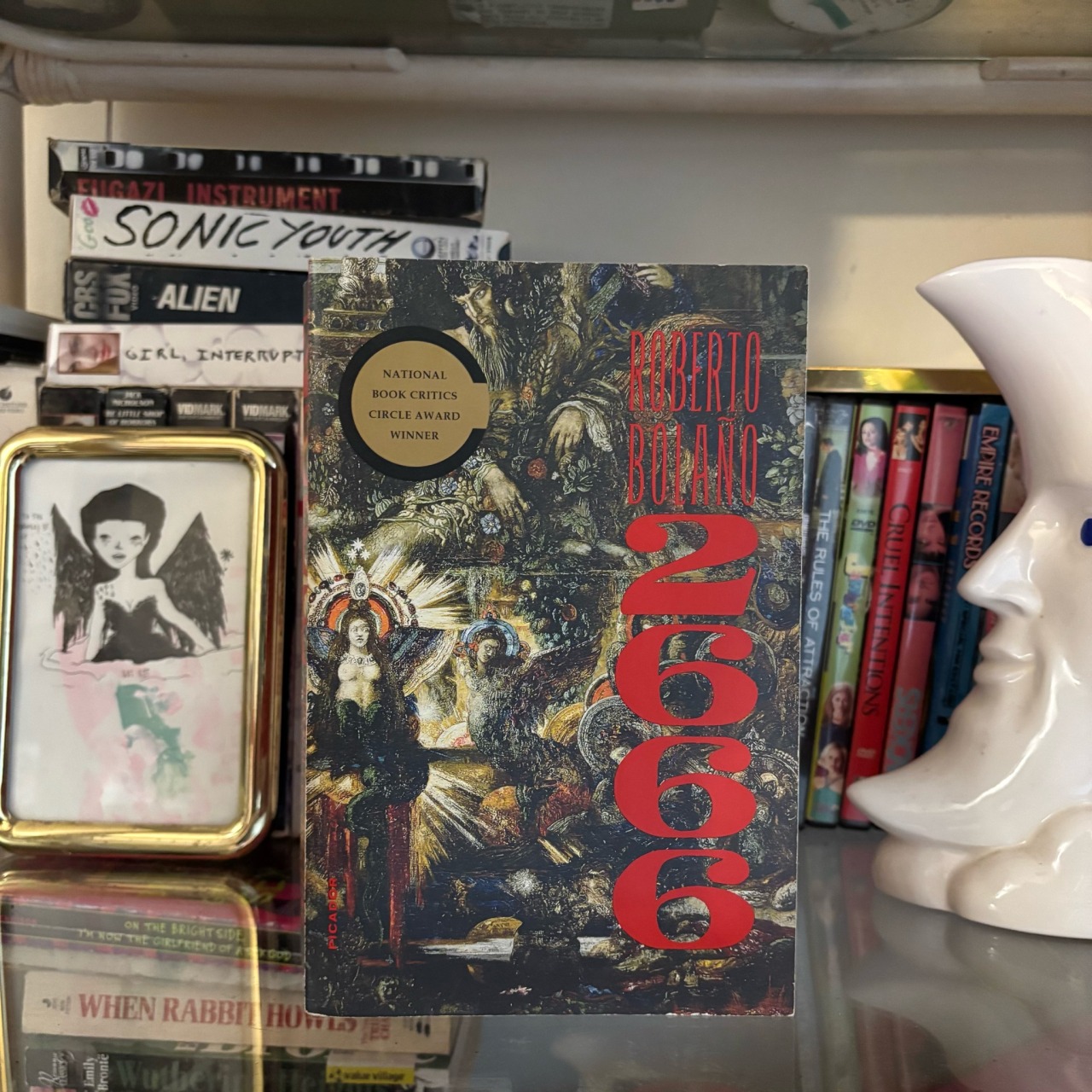
If you have even half a foot in any sort of literary fiction circle, you have heard of 2666. I was encouraged to pick it up by a discord friend, but with descriptions like “grotesque masterpiece” being thrown around, it wasn’t hard to convince me to take the dive. And I’ll be honest, my first impression was a little confounding. 2666 did not immediately pull me in; in fact, its beginning almost feels designed to push people away. For starters, Bolao’s prose is like water, in the way that it is very neutral and flat, but unlike a still lake, there is almost nothing beautiful about his use of language whatsoever. In a way, Bolaño’s prose is like a mirror, in the way that he presents an unaltered image of reality, as ugly and harsh as it can be, and leaves the beholder to project their thoughts and feelings upon the image. Second, the first part of the novel, “The Part About the Critics,” reads like an academic paper, full of dates and names and references to authors and various novels and literary journals. Once the ball gets rolling, the characters actually become quite interesting, and the story picks up intrigue rather quickly, but the setup was very dry. Third, and this is the last that I will say of my confounding first impressions, the first part ends with zero concrete resolutions before abandoning our initial cast and jumping into a new plotline. Little did I know at the time that this lack of resolution would end up being a key to the overarching themes of the novel.
So, I could easily see how some people could DNF the book right then and there. It isn’t particularly inviting, but even during that first part, I could tell that there was something bubbling beneath the surface. Despite the dry language, Bolaño still utilizes lots of imagery by way of dream sequences and symbolism to lay breadcrumbs and create a generalized feeling of unease.
I’m not going to go over every part in depth, although I will say part two, “The Part About Amalfitano,” was maybe my least favourite (although I did love how it recurred the theme of mad artists living in insane asylums). I enjoyed part three, “The Part About Fate,” quite a bit. There was something quite Pynchonesque about it (I believe it even referenced sewer alligators at one point), and it really started to build up the intensity of the novel. Part four, “The Part About the Crimes,” is by far the most infamous part of the novel due to its many clinical descriptions of rapes and femicides that are based on real events that occurred (and sadly still occur) in Ciudad Juárez, Mexico (named Santa Teresa in the novel). This part of the novel has been highly scrutinized, with many critics calling into question the moral imperative of Bolaño himself, but I am of the opinion that Bolaño was noble in his intention to force the brutal reality of the situation down the reader’s throat until you either turn away or confront the ultimate darkness of humanity. This part also functions (and maybe Bolaño would have saved himself some scrutiny by making this more clear) as a condemnation of the Mexican government, their corruption, and their complicity in the crimes. The fact that almost every attempt to uncover the truth was thwarted by negligence or “mysteriously” disappearing evidence was one of the utmost frustrations of the whole book. Once again, Bolaño leaves us with no resolutions—only anger.
Part five then moves past the crimes and focuses on the life of Benno von Archimboldi, the author who the critics in the first part of the book spend their lives obsessing over. I was really excited about this part, as the mystique of this fabled author was built up so heavily, and it was sort of teased as to whether or not he was involved in the crimes, and I wasn’t disappointed. This final part was a masterpiece in and of itself and could have functioned as a standalone novel. The switch from Mexican crime lore to a bildungsroman set in WW2 Germany was kind of jarring, but once you settle into the flow, the story of Archimboldi becomes quite gripping, and the way it eventually all connects back to Santa Teresa was a stroke of genius. Bolaño skillfully uses the concept of Germany as the “conscience of the world” to draw a connection between the atrocities of the Holocaust and humanity’s pervasive spiritual sickness that gives way to an epidemic of femicides in Mexico, and it left me with a lot to chew on.
I’d be lying if I said all of this was clear to me immediately upon finishing the book. I was mostly left with a feeling of grief and exhaustion, and it took a lot of ruminating and discussing the book with others to start piecing my thoughts together. The thing about 2666 is that Bolaño really doesn’t make it explicitly clear what he is trying to say with this novel. Once again, the lack of resolutions in each part speaks for itself. Bolaño seemed to feel as if the darkness of the soul is unfathomably deep and incomprehensible, and he set off to try and translate the feeling of trying to connect the dots and find meaning in it. But there is no clear-cut answer. There is no easy solution. There are no happy endings. And while there is so much more that can be discussed about the novel, about all of its various symbols that it utilizes and the connective tissue that ties the five parts together (I have failed to even touch on the themes of personal legacy that tie directly into Bolaño’s life as he spent his last days writing this), that is ultimately my biggest takeaway from the experience. Upon closing the final page, 2666 may have left me more bewildered than anything, but it has continued to grow in my mind like a tumor, and I don’t think I’ll ever forget it. It’s bleak, it’s depressing, it’s violent, but it’s honest. There is nothing else like it.
Leave a Reply