🌕🌕🌕🌕🌕
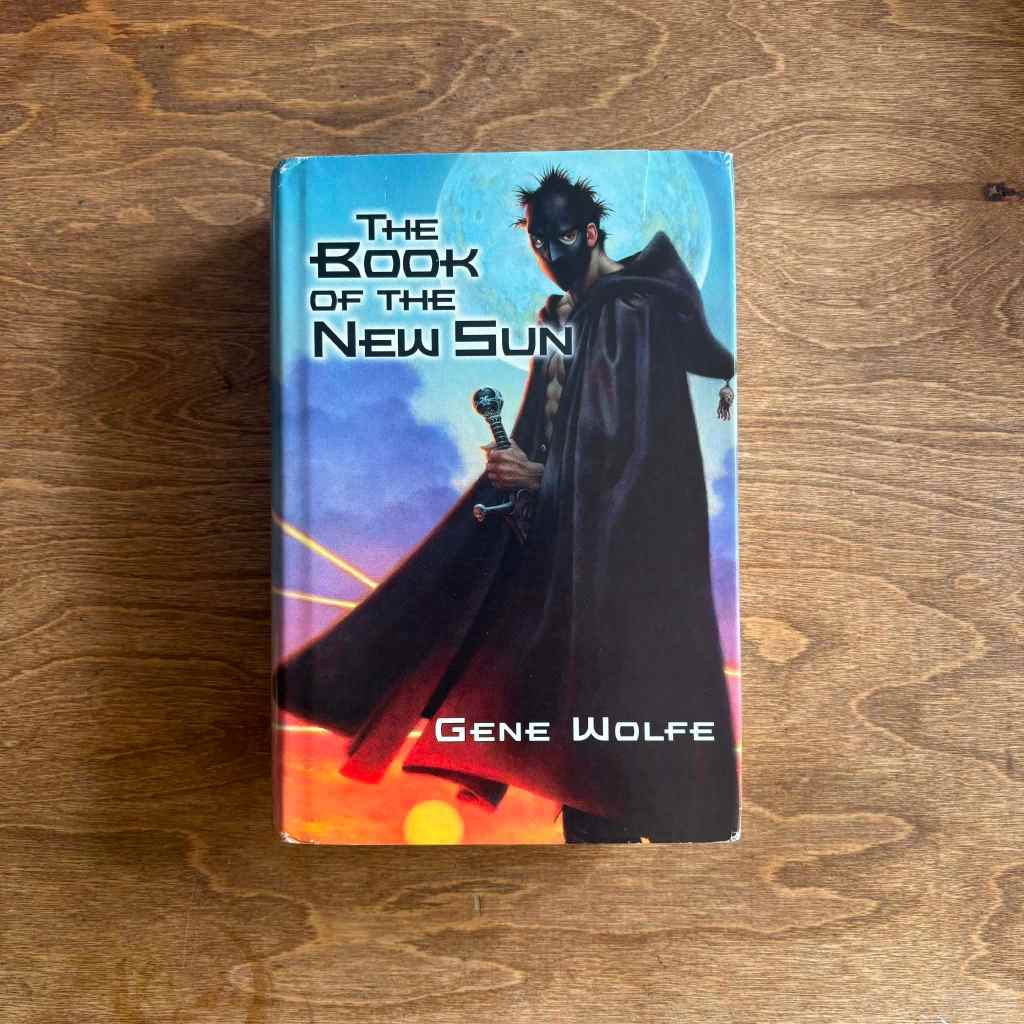
This one is hard to write about. If you know, you know, but I’ll be honest – y’all set me up for thinking this was going to be the most difficult to understand series of all time. I was terrified. But when I finally dived in, I was pleasantly surprised by what I found. The water was cool, and the current was easy to follow. This is your sign! If you are on the fence and put off by all the reviews making it sound like you need a PhD in astrophysics or a bunch of in-depth guides to understand the book; don’t be afraid. Gene Wolfe will swaddle you like a little baby and whisper dark poetry in your ears.
The Book of the New Sun, underneath all of its complexities, has the wire frame of an adventure novel. In a way, it plays out quite like a video game. Severian commits a crime, gets exiled from his guild, and on his journey out into the world becomes entwined with interesting characters and gets his attention pulled by side quests and love interests that all end up being important and interconnected later down the road. I think any avid sci-fi fantasy reader who is comfortable with holding on to multi-threaded narratives and even vaguely familiar with the concept of parallel timelines and simultaneity shouldn’t have a problem. The ability to be okay with confusion and trust in the author is also a requirement, which shouldn’t be new to you if you’re even considering this. I also have to shout out the Teixcalaan duology by Arkady Martine for priming me for the idea of assimilated memories from another consciousness that emerge in thought as well as harder to detect endocrine and nervous system responses.
So I don’t mean to undersell the complexity of The Book of the New Sun at all, for it is indeed rich with high concepts. There are so many layers to be found that make you consistently look back and recontextualize older parts of the story to look for hints or signs of influence, and putting the pieces together is a huge part of the fun. The reader is almost forced into becoming a detective, but if you catch onto these things early and learn to question basically everything you read, Severian doesn’t end up sounding as unreliable as people make him out to be.
Regardless, it is still not a breezy read. Gene Wolfe’s prose is dense, chewy and archaic, including lots of forgotten historical words that honestly aren’t that intimidating as long as you can loosely group them into terms that relate to position and rank and which ones are the names of weapons or beasts. Like bittersweet toffee, every paragraph gets stuck in your teeth, sometimes requiring multiple jabs of the tongue just to make sure you actually grasped the bare concept. Wolfe forces you to pay attention, and that is part of what makes this such an engaging read. I read both of these in less time than I usually read a much shorter stand-alone, because I just found myself addicted to the way that Gene Wolfe paints his world – the dark, gritty, philosophical nature of the story, and all of the biblical symbolism on top of it. This also has one of my favourite settings in sci-fi that doesn’t get explored nearly enough; a future so far ahead that humanity has experienced a sort of rubber banding effect, doubling back on itself until the disparity and destruction creates a dichotomy of swords and space ships.
Overall though, TBOTNS is basically one big character development arc. It’s a redemption story, albeit an ambiguous one with many interpretations. Gene Wolfe takes someone who is part of possibly the most depraved and morally bankrupt positions in society (in this case, a torturer and executioner), and follows him as he leaves the brutal and insular culture of his upbringing and is guided toward a higher purpose. It’s not a quick process. Severian is self aware of his shortcomings, often recognizing his own mistakes and noting the moments when he acts in poor judgement. But like most people, he is also sometimes unaware of when he hurts people. He’s a very real character, full of all the pitfalls of the average man. Yes this includes some misogyny and oversexualization of female characters, and I don’t blame anyone for getting caught up on those points, but it’s important to remember that Severian is a product of his environment (an all-male guild of torturers ffs), and and his behaviour does improve in the third and fourth books. He also frequently expresses his struggle to understand the difference between love and lust.
Severian does terrible, terrible things repeatedly throughout his journey, but he consistently reflects on his actions and emotions and over time his morality becomes more guided by a desire to do good as he is haunted by his past (and future). There is also a noticeable tone shift in the books as this development occurs, and by the time you reach the end you will really feel as though you traversed the absolute blackest pits of humanity and climbed toward spiritual enlightenment. It’s one of the most brilliant and drawn out character studies of all time. But Gene Wolfe didn’t only pour his attention into Severian. Almost every character, no matter how brief, is portrayed in such a complex and ambiguous light, where their motives and history are hard to know or understand, but they are all so memorable nonetheless.
I’m just ranting at this point, but there is truly so much to discuss with these books, and I can only imagine how many more details could be illuminated by a second read. I’ve hardly scratched the surface as it is. I ordered Urth of the New Sun, the final book that Wolfe tacked on a few years later, and I’m very excited. This is a cult classic for a reason.
Leave a Reply