🌕🌕🌑🌑🌑
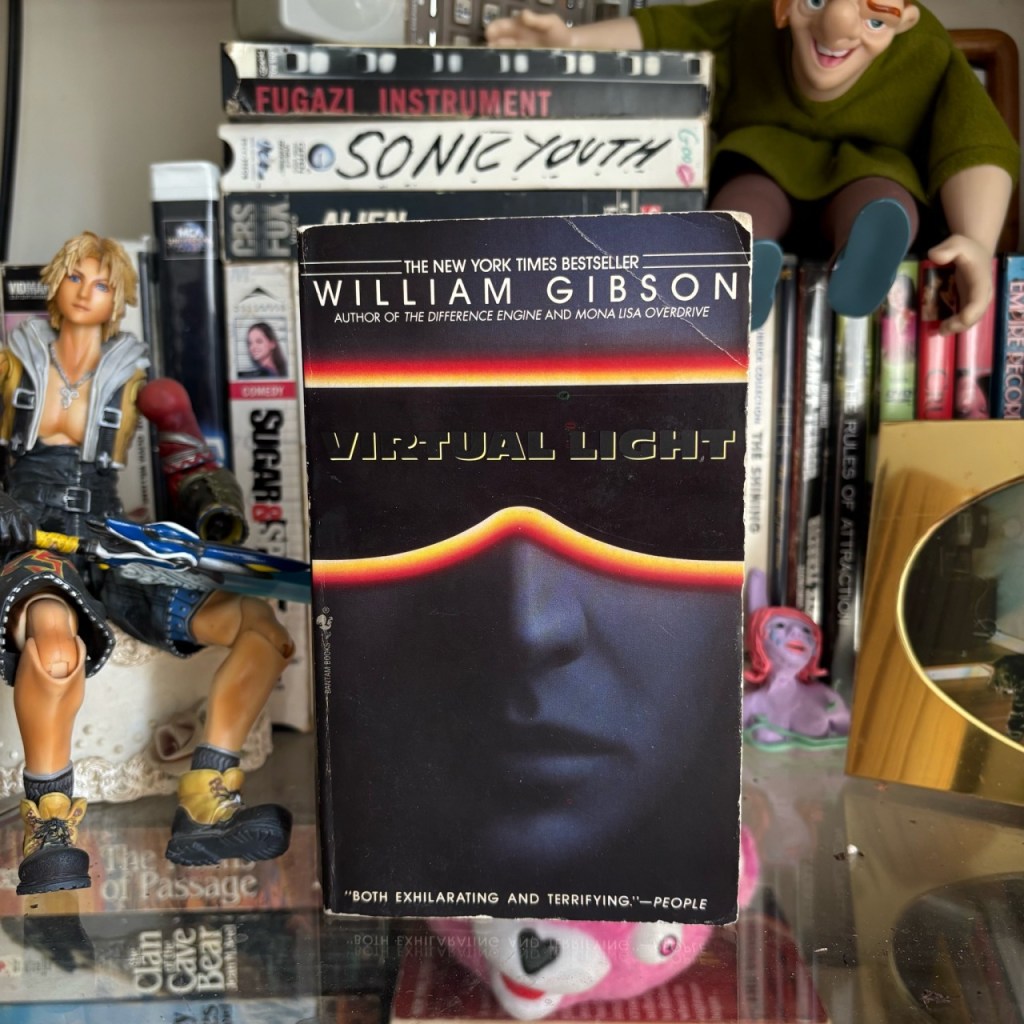
I was really excited to get back to reading some Gibson and see what he can do outside of the Sprawl setting, but this was unfortunately a bit of a disappointment. Prose-wise, this is still classic Gibson—full of janky syntax and a bad habit for narrating everything like notes on a police report, providing a ton of zoomed-in imagery but little in the way of context to tie things together. I keep underestimating how little Gibson cares about holding the reader’s hand. Just like all his other books that I’ve read, it probably took about 50-100 pages for the narrative to really become clear. Gibson likes to set up his stories like an investigation board with snapshots of suspects and scenes that slowly converge into a single lead, and it usually works as long as the stakes are high and the payoff is explosive—two things Virtual Light lacks almost completely.
There were definitely some cool things going on in this book, but none of them were applied in a way that actually strengthened the main plot (apart from Chevette and Sammy Sal being bike messengers; that was actually cool). Gibson’s worldbuilding of an alternate Los Angeles and San Francisco was great. The condemned bridge to Oakland that had been converted into a lawless shantytown was especially a fascinating setting; it almost felt like the labyrinthine gothic castle from Gormenghast that just kept growing and growing until it resembled an M. C. Escher painting of nonsensical architecture. That setting definitely could have been explored further and made into a larger part of the story. There was also some interesting cultural stuff going on on the sidelines; Gibson was clearly impacted by the AIDS epidemic while writing this, and part of his alternate reality was one in which a non-lethal strain of HIV was found in the blood of J.D. Shapely, who became a sort of patron saint figure for the communities that lived on the bridge; then there was a separate religious cult out in the suburbs of L.A. who believed God could be found in old movies and TV shows and would just set up stacks of dead televisions all over the place, yet they had rules about what material could be viewed, and one of the characters gets labeled as an apostate for getting caught watching Videodrome.
Yet somehow Gibson managed to craft a main plot that completely sidelined all of these interesting tidbits of cultural worldbuilding to instead focus on a dull investigation about some stolen virtual reality sunglasses and a secret plan to rebuild San Francisco that both felt so disconnected and unimportant despite at least two or three people getting killed over them. Not even the characters could come up with an argument for why anything they did mattered—hell, the whole thing starts because Chevette jacks some random guy’s sunglasses on a total whim. “Exhilarating and terrifying” my ass. If I was Gibson’s editor, I would have sent him back to the drawing board on this one. A good story does exist in this world; this just isn’t the one. Hoping to have better luck with Idoru.
Leave a Reply