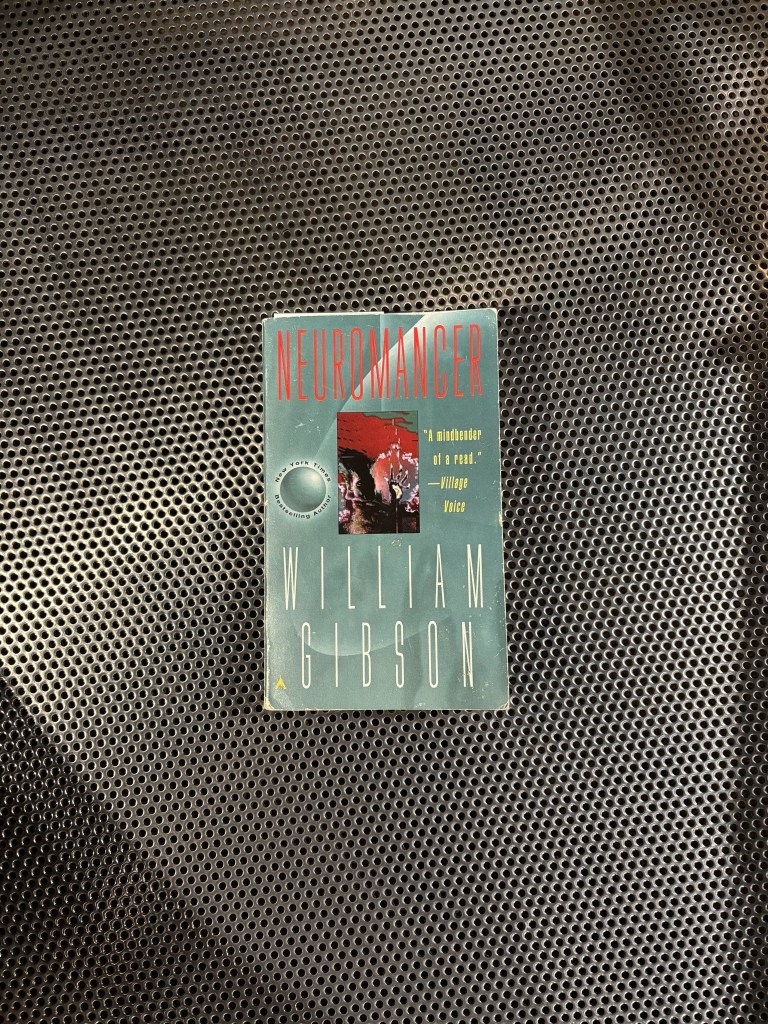

The first time I read Neuromancer, I didn’t understand it. It was thrilling, yes, visionary, even—a prophetic tale of dystopian tech drenched in degenerate psychedelia and hardcore action—but also so, so confusing. Gibson does not hold the reader’s hand. In a 1999 interview, he opines that we “live in an incomprehensible present” and that it is not his duty to explain the present but merely to illuminate the moment and make it accessible. If making incomprehensibility accessible was his goal, he achieved it.
But then I read it again a few months later, and it was like putting on a pair of glasses after a lifetime of legal blindness, or activating the windshield wipers during a storm. Johnny Nash wrote a song about this feeling once.
My familiarity with the plot and the mechanics of cyberspace allowed me to sit back and enjoy the ride, and what a ride it was. My main takeaway from that second read, however, was that while Neuromancer is obviously an impressively innovative novel, its reading experience was handicapped by its preoccupation with stoicism. The characters just didn’t offer me anything outside of being cool. They are all people of few words—steely individuals who keep their cards close to their chests and their conversations to a minimum—individuals who aren’t motivated by any sense of justice, duty, or loyalty, and who harbor no ideology but self-interest and survival. The result was a fun, visually stimulating novel that ultimately failed to engage my empathy. I truly felt at the time that this was the result of poor characterization and that a more emotionally dynamic cast would have improved the story tenfold.
But then I read it a third time, and I completely changed my mind. With two Neuromancer runs under my belt, I was able to immerse myself in the nooks and crannies of Gibson’s prose, and I suddenly recognized the characters’ lack of emotional dimension as not only a fully appropriate product of their environment but also a crucial aspect of the novel’s themes. How did I miss it the first two times? These characters live in a hypercapitalist future that is designed to flatten people, for god’s sake. Night City forces its inhabitants to expel their humanity in order to get ahead and rewards their callous individualism with spoils on the black market. Case sees it in Armitage as a “gradual and willing accommodation of the machine, the system, the parent organism.” The human experience has been cheapened, and the gulf of connection has grown ever more expansive. We are experiencing this same cheapening of reality right now with the growth of social media and algorithms that are designed to divide us and exploit our dopamine receptors.
So forgive me if I feel a little bit of empathy for these cold and two-dimensional characters. Case is a stimulant addict whose livelihood and passion have been stripped from him, diminishing his self-worth and forcing him into a life of petty crime where he becomes so desensitized to violence that he no longer cares if he lives or dies. Molly is a traumatized sex worker whose only good partner in life was assassinated in cold blood, and the only time she feels comfortable opening up to Case about her past is when she knows he can’t respond because it reduces the risk of her vulnerability. Armitage was used by the government, sent on a suicide mission, betrayed and broken beyond recognition, leaving behind his eyes the “blue-gray image of a howling waste of snow, the stripped black trunks of evergreens bending in silent winds.” By the time the AI picks them up to execute its emancipation, half the work has already been done; they are vacant shells ripe for exploitation.
This destructive synthesis of technology and the human spirit is illustrated brilliantly by the correlation between the shapeless, nameless anger that consumes them and the viruses that run rampant in cyberspace. Case looks into the heart of the Kuang virus and watches as “childhood symbols of evil and bad luck tumble out along translucent planes: swastikas, skulls and crossbones dice flashing snake eyes.” Fascism has woven itself into the matrix. Wintermute’s defense system appears as “an arm of shadow uncoiling from the flickering floor below, a seething mass of darkness, unformed, shapeless….” Ashpool’s cryogenic dreams grow like slow “ice” (the same word that is used for cyberspace firewalls), turning his immortality into a sickness. The patterns of human misery are replicated in our technology and then reflected back at us in dialectic fashion, creating a feedback loop that only brings us closer to decay. By the end of the novel, Molly and Case are right back where they started—guarded, distrustful, emotionally unavailable. When Molly leaves, Case throws away the last reminder of her, claiming a lack of need in order to rationalize the pain, and when he flies over Rio’s beach in cyberspace and sees the copy of himself standing in the surf with Linda, it’s easy to wonder if that version of him is happier than the one who escaped.
Three reads in and the sadness of Neuromancer finally revealed itself to me. The dimension of character that I assumed to be missing was indeed a feature, not a flaw, and I’d be lying if I said I didn’t shed a tear in grievance of their dead, withered selves.
It would have been so easy for Gibson to take this world that he created—one that is so clearly entrenched in global corruption, unethical technology, and extreme wealth disparity—and write a heroic tale of good versus evil with clear-cut villains for the reader to rally against, but he didn’t. Not even Wintermute or Neuromancer can be construed as purely evil entities. Instead, he took what I consider to be the harder route and wrote a morally ambiguous tale about how technology flattens people and exploits their anger to undermine their freedom of will. There is absolutely something political to infer from that, but it’s not the point of the story. Gibson isn’t trying to make an argument for or against anything; this isn’t a manifesto. He’s barely even trying to make an argument for humanity itself, he is just trying to make the incomprehensible present accessible, to give it a shape that can be explored, and that is why Neuromancer will always stand the test of time, not only because it was a revolutionary and prescient piece of literature, but because it has no ideological argument that can be dismissed, debunked, or outlived, and at the end of the day, it’s just fucking cool.
Gibson himself claimed to not be a didactic writer, saying that he wants nothing less than to be someone couching a conscious message in prose fiction, but that when he looks back on his earlier work, he sees a struggle to recognize and accept that the heart is the master, and the head is the servant, and that when that is no longer the case, we are in deep, deep trouble.

P.S. Riveria can still get fucked, that dude is an irredeemable pervert.
Leave a Reply