🌕🌕🌕🌕🌑
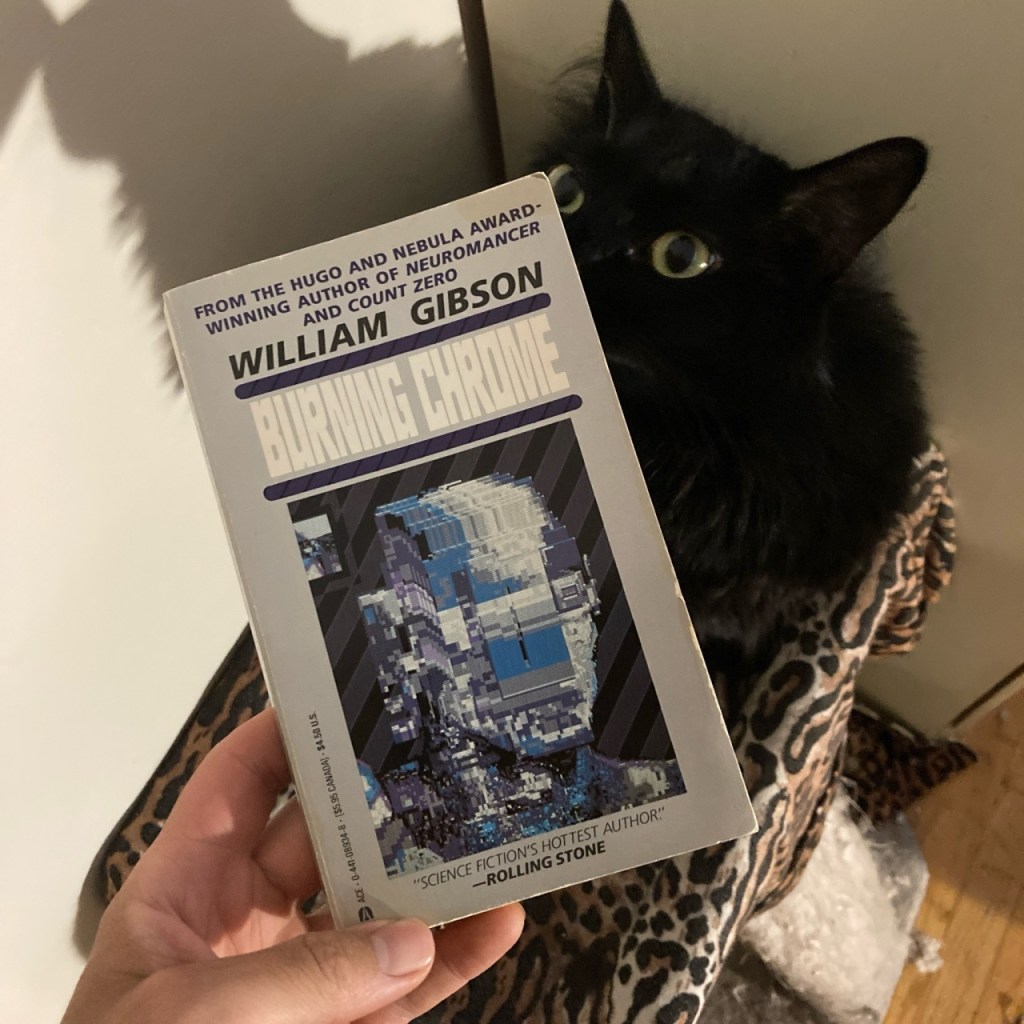
Felt nice to revisit Gibson. Neuromancer was the book that got me back into reading and made me realize how much I love sci fi, and it feels like so long ago now that I wrapped up Mona Lisa Overdrive. I didn’t know how interested I would be in reading a book of short stories, but when I saw this copy sitting on the book store shelves I couldn’t say no (1987 print, way cooler than the newer versions).
I’m really glad I decided to pick this up. These stories contain some of Gibson’s most imaginative writing, but also some of his most challenging. Just like his other books I’ve read, I found the best way to get through it was to not get caught up in the details. There is just a ton of psychedelic technobabble here that is really hard to follow or even imagine for anyone except Gibson himself. Considering how many times drugs are brought in these stories, I almost wonder if he was tripping when he wrote some of this (or maybe I’m just dumb). I mean, I had to read “Fragments of a Hologram Rose” twice and still have no fucking clue what happened. At least the short story format makes re-reading small sections a breeze, and there is plenty reward in doing so. Gibson is usually good at revealing concrete information toward the end of his stories, so going back to the start with that information can really shed a light on everything else.
“Johnny Mnemonic” and “Burning Chrome” were two of my favourites since I was already familiar with the Sprawl setting, and seeing some familiar characters make cameos was a nice touch. I also really connected with “The Winter Market” because it referenced a lot of actual locations around the city I live in. It was neat to be able to picture exactly where the characters were. Gibson’s attempts at Soviet Space Propoganda was an odd surprise but also neat cause it reminded me a lot of Omon Ra by Victor Pelevin in the way that it was simultaneously depressing and absurdly comedic. I found the three collaborations stories in this book to be some of the most narratively coherent—probably the result of having someone else keep Gibson on the rails. All of these stories were good at something though, even if that something was just pure technologic hallucinations.
Despite all of the dense, flashy, and often nonsensical sci fi imagery, a lot of these stories are actually very sad—often leaving you with a stark image of addiction, alienation and loneliness. It made me realize just how much focus and impact a short story can have (and may have inspired me to try writing my own). Getting to really zoom in close on some of Gibson’s character studies and strange thought experiments was a delight, even if it was sometimes hard to grasp. Highly recommended if you enjoyed the Sprawl trilogy. It made me really want to re-read Neuromancer and also check out some of the Bridge books.
Leave a Reply